REVIEW · NEW DELHI
Half-Day Delhi Temple Tour with Pick-Up & Drop-Off
Book on GetYourGuide →Operated by Go City Adventures · Bookable on GetYourGuide
Six faith stops in one comfortable day. This half-day Delhi temple tour strings together iconic spiritual landmarks with real context, and I like that the day is guided end to end through temple culture and the best part is the chance to see the community kitchen at Gurudwara Bangla Sahib. It’s also a smart way to get your bearings in Delhi without hopping around on your own.
One thing to plan for: the schedule is fairly tight, and you may need to follow shoe rules on the spot at different temples, so it helps to wear easy socks or slip-ons and be ready to move quickly.
In This Review
- Key highlights at a glance
- How the 5–7 hour temple route fits into your Delhi day
- Lotus Temple: the calm, lotus-shaped entrance to the day
- ISKCON and Prachin Hanuman Mandir: two devotion styles, same city energy
- Akshardham’s temple complex and the light & water show finale
- Gurudwara Bangla Sahib: more than a temple visit
- Birla Mandir (Laxminarayan): a big closing shrine with multiple connections
- Price and value: what you’re paying for at $31 per person
- Logistics that actually affect your comfort (AC, pacing, and shoe handling)
- How to get more out of the tour (questions to ask your guide)
- Who this tour suits best
- Should you book this Delhi temple tour?
Key highlights at a glance
- Air-conditioned pickup-and-drop-off across Delhi/NCR so you start relaxed and end back at your hotel
- Lotus Temple first, then classic devotion stops like ISKCON and Prachin Hanuman Mandir
- Akshardham Temple complex + the light & water show for a strong evening finale
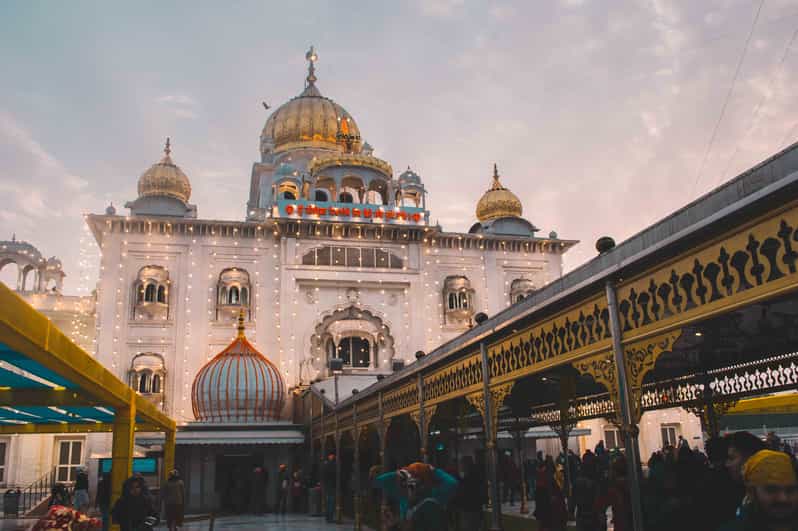
- Gurudwara Bangla Sahib’s community kitchen gives you more than sightseeing—it shows service in action
- Birla Mandir (Laxminarayan Temple) as a calm closing temple with multiple shrines in one place
How the 5–7 hour temple route fits into your Delhi day
This is one of those tours that feels simple on paper: hotel pickup, a guided loop of major temples, then drop-off. In practice, it works because the route covers a wide spread of Delhi’s spiritual landscape in a short window, so you’re not stuck bouncing between far-apart neighborhoods all day.
You’ll typically be picked up from one of five areas—New Delhi, Delhi, Gurugram, Noida, or Ghaziabad—and dropped back in the same region. That matters because Delhi traffic can be unpredictable, and having a planned transfer saves time and stress.
The day runs about 5 to 7 hours, depending on the option you choose and how the timing lands for the evening show at Akshardham. If you’re traveling with another person and want a shared, structured experience without thinking too hard about logistics, this format is a good match.
You can also read our reviews of more tours and experiences in New Delhi


Lotus Temple: the calm, lotus-shaped entrance to the day
You start at the Lotus Temple, with a guided visit around 30 minutes. The reason this stop works so well at the beginning is that the architecture sets a tone—clean lines, lotus-like form, and tranquil grounds. It’s a good “first read” for understanding how Delhi can feel both busy and quiet depending on where you are.
You’re not just looking at a landmark. With a guide, you’ll get the spiritual and cultural context behind what you’re seeing, which is the whole point of doing a temple tour with interpretation. Without that, it’s easy to treat each site like a photo stop.
A practical note: start-of-day temples often work best when you’re mentally ready to slow down a bit. If you rush here, you’ll miss the calm, and that calm is kind of the feature.
ISKCON and Prachin Hanuman Mandir: two devotion styles, same city energy
Next comes ISKCON Temple, New Delhi, guided for about 40 minutes. ISKCON is dedicated to Lord Krishna, and the atmosphere is very different from Lotus Temple. This is where the tour starts feeling more like you’re stepping into daily devotion rather than just admiring design.
After that, you head to Prachin Hanuman Mandir in Connaught Place for roughly 30 minutes. Prachin Hanuman Mandir is one of Delhi’s older temples, and it’s described as tracing its roots back to the Mahabharata era. That’s a big statement, and it’s exactly the kind of detail a guide can help you understand without turning the day into a textbook.
If you’re the type who enjoys contrast—new versus old, different faith expressions, different temple rhythms—this middle portion is your payoff. You’ll see how devotion can look and feel different while still being deeply connected to tradition.
Akshardham’s temple complex and the light & water show finale
Then you reach Akshardham Temple, guided for about an hour. It’s known as the world’s largest Hindu temple complex, and the tour experience is built around that scale. The best way to enjoy it is to treat it like a full stop, not a quick photo session. Even with guided time, it helps to go in ready to notice details and listen.
Akshardham’s big moment is the evening light & water show, which is the finale of the tour. This part is valuable for two reasons. First, it’s a visual way to connect stories to the place you just visited. Second, it gives structure to the end of your day so you’re not wondering what to do next once the temples blur together.
Now, a consideration: Akshardham is large, and not every tour may highlight every possible indoor exhibit the same way. If this is your main priority, I suggest asking your guide directly to spend time on the indoor areas you care about, not just the exterior views.
Also, plan to stay patient here. You’re wrapping up the tour while everyone else is doing the same. That doesn’t mean the experience is worse—it just means your mindset should be flexible.
Gurudwara Bangla Sahib: more than a temple visit
After Akshardham, you go to Gurudwara Bangla Sahib, guided for about 35 minutes. This is Delhi’s prominent Sikh temple, and it’s famous for the community kitchen and the spirit of service.
This stop is one of the most praised parts of the tour for a reason. The community kitchen experience isn’t just about watching something unusual—it’s about witnessing how hospitality and faith show up as action. It gives you something you can’t replicate with photos.
If you’re trying to understand dharmic religions in a human way, this is where it becomes tangible. You see that spirituality isn’t only about architecture or rituals—it’s also about how people care for one another.
A quick practical thought: treat this part with respect and follow whatever guidance you’re given on-site. You’ll get more out of it when you slow down and observe what’s happening around you.




Birla Mandir (Laxminarayan): a big closing shrine with multiple connections
Your final temple stop is Birla Mandir (Laxminarayan Temple), with a guided visit around 40 minutes. This is described as a sprawling complex dedicated to Lord Vishnu, and it also includes shrines for Buddha, Ganesha, and Laxmi.
That mix is part of why it works as a closing stop. By the end of the day, your brain has already shifted through multiple faith contexts. Birla Mandir gives you a place where different devotional threads are visible in one area, which helps you connect what you’ve learned rather than treating each stop as separate and unrelated.
If you want a calm ending after the bigger spectacle of Akshardham, this is a good choice. It’s also a nice “final look” temple when your legs are tired and you still want one more guided explanation before you head back.
Price and value: what you’re paying for at $31 per person
At $31 per person, this tour sits in the budget-friendly zone for a guided temple circuit in Delhi. But the best way to judge value is to look at what’s included.
You get:
- Hotel pickup & drop-off
- An English/Multilingual tour guide (English, Spanish, German, Italian, French)
- Shoe-keeping fee
- Sightseeing aligned to the route
And you don’t get:
- Meals and drinks
- Entry tickets to Jama Masjid
- A rickshaw ride in Old Delhi (relevant if you combine with Old Delhi options)
Here’s the key value point: many temples are free to enter, so the real cost is the guide’s time and the comfort/effort of transportation. That’s also why guide quality matters. When the guide explains clearly and keeps things engaging, the price feels fair. When the guide is more of a driver-with-a-script, the same price can feel heavy.
One review mentioned a guide named Suraj as particularly strong—especially for the Sikh temple and kitchen experience. That matches what you want from a tour: someone who helps you notice what matters.
Logistics that actually affect your comfort (AC, pacing, and shoe handling)
You’re traveling in an air-conditioned ride, and that sounds basic, but in Delhi it’s a genuine comfort upgrade. It also reduces the mental load. When you’re not dealing with transport decisions, you can focus on temples.
The pacing is the real variable. You have guided times at each stop—often 30 to 40 minutes—so the tour is designed to keep the day moving. If you like long, quiet reflection at one site, you might wish you had more time somewhere. If you like seeing a lot without planning, you’ll probably feel satisfied.
On shoe handling: the tour includes a shoe-keeping fee, which suggests you’ll deal with shoes during temple visits. And in practice, you should expect you may be asked to remove shoes at some points. Plan for it. Wear something easy and avoid anything complicated that slows you down.
How to get more out of the tour (questions to ask your guide)
If you want this tour to feel like more than a checklist, use your guide actively. Here are a few smart questions you can ask at any stop:
- Which part of this temple is easiest to misunderstand as a visitor, and what should I look for instead?
- What’s the story behind the key site detail I’m seeing right now?
- At Akshardham, can we prioritize the indoor exhibits that explain the place beyond the main displays?
A guide who’s enthusiastic and clear can make each stop feel connected. Even with the tight schedule, you can steer your day toward the meaning you care about.
Also, if your main goal is the Akshardham light & water show, treat it as a priority. Arriving ready for a packed evening helps you enjoy it rather than counting minutes.
Who this tour suits best
This works especially well if you:
- Want a guided introduction to major Delhi temples without self-planning
- Like cross-faith learning across Hinduism and Sikhism, plus a major Baháʼí site like the Lotus Temple
- Prefer comfortable transportation and hotel pickup over negotiating your own route
- Are okay with a structured day where you see several major highlights rather than lingering for hours at one place
It may feel less ideal if you’re the type who needs deep, slow time in museums or indoor exhibits everywhere. With a multi-stop route, you’ll get guided highlights, not total freedom.
And if you’re combining experiences—like temple add-ons for Old Delhi or Gandhi’s Journey in Delhi—this tour can be a strong foundation. Just remember that some add-on elements may have costs not included in the base price.
Should you book this Delhi temple tour?
I’d book it if you want a well-paced spiritual sampler of Delhi with real guidance, especially if the idea of seeing Lotus Temple, ISKCON, Hanuman Mandir, Akshardham, Gurudwara Bangla Sahib, and Birla Mandir in one day sounds like your kind of travel.
If you care most about one single temple—especially Akshardham—and you’re picky about indoor exhibits, go in with a plan to communicate your priorities early. And because cancellation experiences can vary in real life, double-check the terms before you commit.
Overall, for $31 with pickup, a guided route, and a show in the evening, this is a practical way to experience Delhi’s spiritual side without turning your day into a logistics puzzle.