REVIEW · JAIPUR
Jaipur: City Palace Museum – Direct Official Ticket
Book on GetYourGuide →Operated by City Palace Museum, Jaipur · Bookable on GetYourGuide
Seven courtyards, one palace ticket. This official City Palace entry gives you access to seven interconnected courtyards and the museum galleries inside Jaipur’s former administrative core.
I also like that the visit is organized around real palace functions, so the rooms feel purposeful rather than random photo stops. You’ll start at Pritam Niwas Chowk and move through key areas like Diwan-e-Khas, Diwan-e-Aam, Mubarak Mahal, and Sileh-Khana, ending with the Rath-Khana transport display.
One drawback to consider: a verified booking report said the ticket didn’t work at entry, and another comment flagged poor condition/rubbish in parts of the palace area. If that worries you, bring a screenshot/backup proof and allow a little extra time at the ticketing counter.
In This Review
- Key things to know before you go
- City Palace Museum ticket: what $16 buys you in real sightseeing
- Finding the ticket counter near Baradari Restaurant
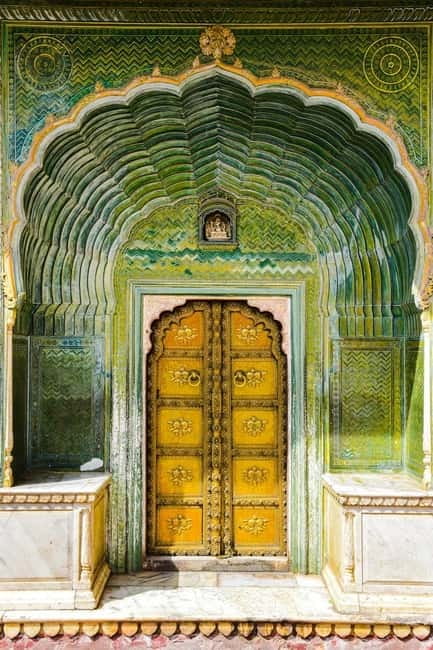
- Pritam Niwas Chowk: four deities and four decorated gates
- Sarvato Bhadra / Diwan-e-Khas: the celebrations courtyard
- Diwan-e-Aam: where the Maharaja heard from the public
- Mubarak Mahal (built 1902) and the textile collection
- Sileh-Khana: arms and armor you can actually picture
- Painting & Photography Gallery: maps and historic photographs
- Rath-Khana: royal transports across three centuries
- Practical notes: walking, heat, and photo rules
- What could go wrong (and how to protect your day)
- Should you book this official City Palace ticket?
- FAQ
- How long should I plan for the City Palace Museum ticket?
- Where do I enter to get the ticket?
- What major areas will I see inside the palace?
- Is photography allowed?
- Are pets allowed?
- Can I bring alcohol or drugs?
- Is the ticket wheelchair accessible?
- What’s the cancellation policy and payment options?
- Does the ticket cover starting times?
Key things to know before you go
- Official ticket from the City Palace: you’re using an entry route tied directly to the palace’s own ticketing process.
- Seven linked courtyards in one visit: you can see how the palace layout connects public, ceremonial, and private spaces.
- MSMS II Museum access: the museum includes four of those courtyards, so you’re not just walking corridors.
- Big-name highlights are tangible: don’t miss the Gangajalis—two huge silver urns—once you reach Sarvato Bhadra/Diwan-e-Khas.
- A strong variety of collections: textiles in Mubarak Mahal, arms and armor in Sileh-Khana, plus painting/maps/photos and royal vehicles.
City Palace Museum ticket: what $16 buys you in real sightseeing
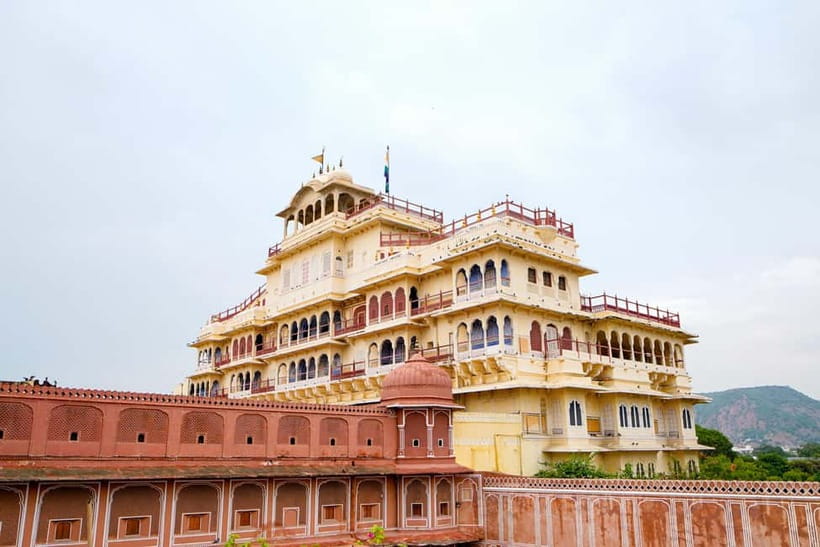
For about $16 per person, this ticket is a straightforward way to spend a full Jaipur morning to afternoon inside the City Palace complex. The best value isn’t only that it’s a palace museum. It’s that you get a guided-feeling layout without needing a separate guided tour.
You’re paying for access to the City Palace courtyards and galleries, plus platform booking fees. That matters in India, because official entry is often the difference between a smooth visit and a messy one at the gate. Starting points and ticket counters can be confusing; having an entry option tied to the palace itself generally makes your day simpler.
Also, this is a museum experience that moves through different kinds of space. You’ll go from entry gates and ceremonial courtyards to halls of public access (Diwan-e-Aam), then into more specialized galleries like arms/armor and textiles. If you like historical places where you can still imagine how the building worked, this one delivers.
And yes, you’ll walk. The courtyards are interconnected for a reason: the palace layout is meant to funnel you through different areas rather than let you hop randomly. Wear comfortable shoes and plan on a slow, steady pace.
You can also read our reviews of more tours and experiences in Jaipur

Finding the ticket counter near Baradari Restaurant
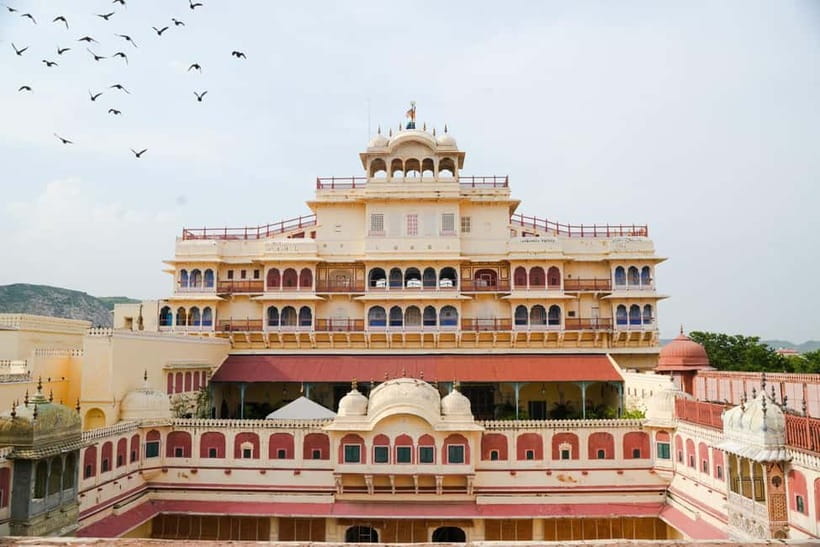
Your entry start point is practical and specific: enter the gate to the ticketing counter near Baradari Restaurant. When a palace is this big, the meeting point can save you 20–40 minutes of wandering. Aim to arrive when you have energy—late-day heat can turn “palace tour” into “palace shuffle.”
Once you have your ticket, you’re free to use the palace courtyards and galleries included with entry. The ticket is valid for one day, and starting times depend on availability. I recommend checking the timing you select, then building your day around it instead of squeezing it into a rushed schedule.
The palace is also listed as wheelchair accessible, which is a big plus if you need help planning your route. Still, you should expect some areas to be easier than others because courtyards and museum buildings often have uneven transitions. If mobility is a concern, going early is usually the smartest move.
Pritam Niwas Chowk: four deities and four decorated gates
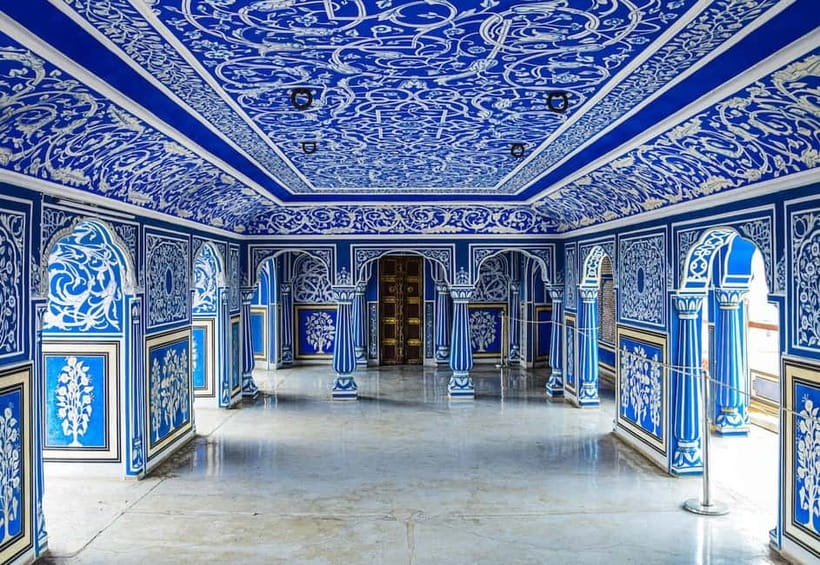
You start at Pritam Niwas Chowk, and it’s a strong opening because it hits you visually before you even get into the deeper museum rooms. The chowk has four magnificently decorated gates (deories) depicting four deities. That’s not just decoration. In palace design, these thresholds help set the tone for what kind of space you’re entering—ceremonial, sacred-adjacent, and officially important.
Take a moment here to orient yourself. You’re stepping into a complex of spaces built for administration and ceremony, not just living rooms. If you like to understand layout, this is where you can get your bearings fast: you’ll see how the palace connects courtyards rather than breaking into isolated buildings.
From here, the tour naturally flows toward a court space that hosted cultural and religious celebrations. Think of Pritam Niwas as the visual prologue, and the next courtyard as where the palace role becomes clearer.
Sarvato Bhadra / Diwan-e-Khas: the celebrations courtyard
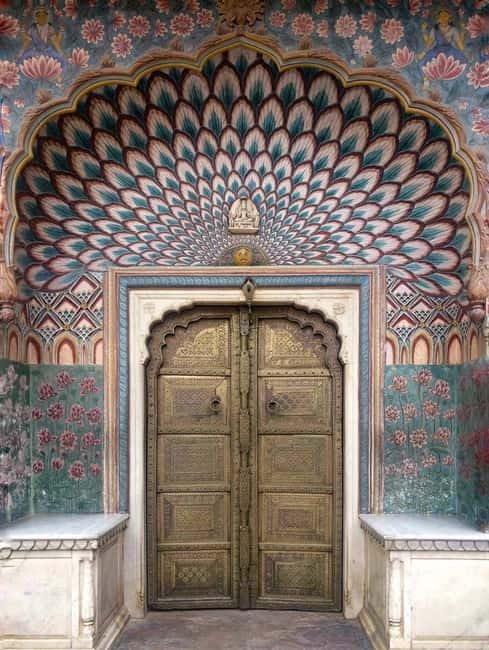
Next you head to Sarvato Bhadra, also known as Diwan-e-Khas. This area is described as a place that hosted religious and cultural celebrations. That helps you read the space correctly: you’re not just looking at walls and arches. You’re standing where events happened, where the palace could stage moments for important gatherings.
When you enter, don’t miss the Gangajalis. These are two gigantic silver urns, and they’re the kind of detail you’ll remember even after you leave. The reason this stop feels satisfying is simple: it gives you a concrete anchor point. Instead of trying to take in everything at once, you have one “must-see” feature that organizes your attention.
If you’re the type who likes to connect objects to purpose, this is a good courtyard to slow down. Celebration spaces often have sightlines and symbolic placements meant for public viewing and ritual timing. Even without a guide explaining every meaning, you’ll feel the intentional design.
Diwan-e-Aam: where the Maharaja heard from the public
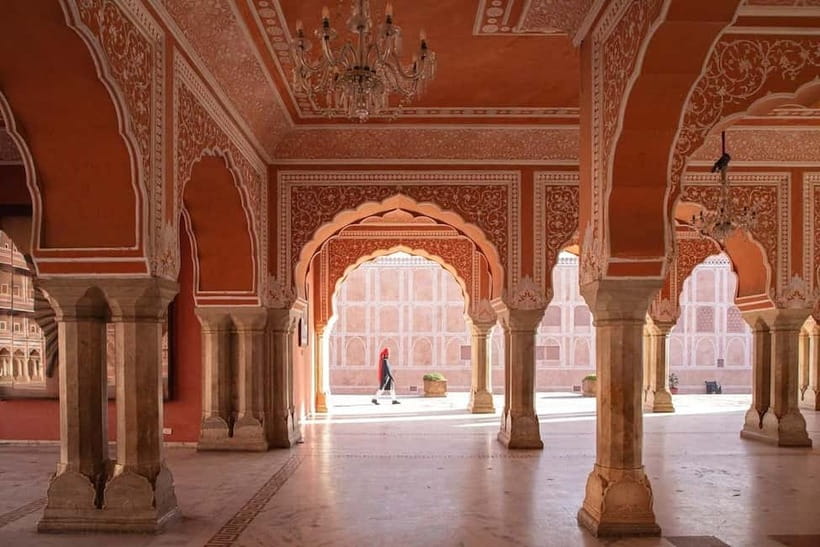
Now the palace shifts gears. You move to Sabha Niwas, also called Diwan-e-Aam, a hall where the Maharaja would hear from his public and greet foreign dignitaries. That “public and foreign” combo is exactly what makes this stop important.
A lot of palace museums focus only on private luxury. This hall is about governance and contact. It’s where you can imagine petitions, announcements, and official greetings happening in a space designed for visibility and ceremony. If you like history that shows how power operated day-to-day, this is one of the most meaningful areas in the complex.
I’d give yourself a bit of time here even if you’re tempted to rush. It’s the kind of hall where your brain automatically tries to reconstruct scenes: who stood where, how conversations might have carried, and how the space directed attention. That mental “rebuild” is part of what makes palaces worth visiting.
You can also read our reviews of more city tours in Jaipur

Mubarak Mahal (built 1902) and the textile collection
Then comes Mubarak Mahal, built in 1902 as a guest house for foreign dignitaries. Today, it houses the textile collection. This change—from hospitality space to museum display—often creates a good “this used to be for guests, now it’s for us” feeling.
Textiles can be tricky in museums because they’re often displayed without context. But in a palace setting, textiles gain extra meaning. You’re seeing materials and craftsmanship that would have mattered for status, trade, and ceremonial use.
If you’re interested in everyday royal life beyond furniture and weaponry, textiles are a smart counterbalance to the heavier galleries. It also provides a visual break after the more architectural and ceremonial courtyards. If the palace is starting to feel like “more rooms,” this stop helps refresh your eyes.
Sileh-Khana: arms and armor you can actually picture
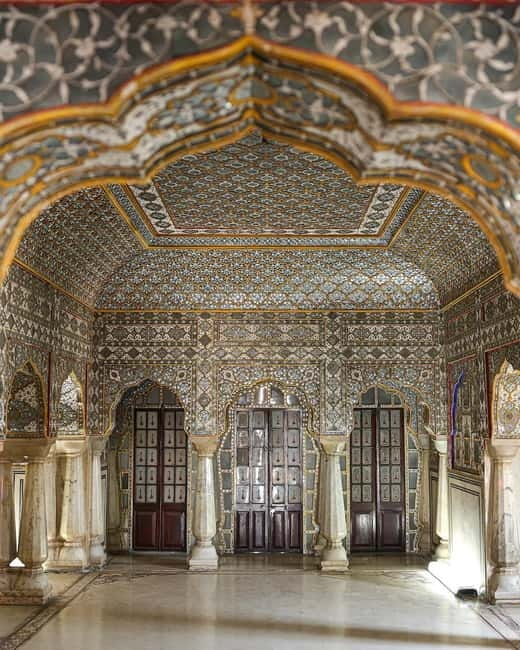
Next is Sileh-Khana, a gallery housing a vast and unparalleled collection of arms and armor. Even if you’re not a weapons person, this stop is worth it because it’s tangible. You can often look at weapons and armor and quickly understand eras, materials, and how designs evolved for use.
The “palace museum” angle becomes real here. A palace isn’t only about ceremonies and textiles. It’s also where authority protected itself. Seeing arms and armor in a palace setting helps connect the political side of the complex to physical tools of power.
I suggest not trying to “read every item.” Instead, pick a few pieces and look closely at how they’re constructed. Even basic observation—shape, ornament, metal finish—can tell you more than a rushed walk-through.
Painting & Photography Gallery: maps and historic photographs
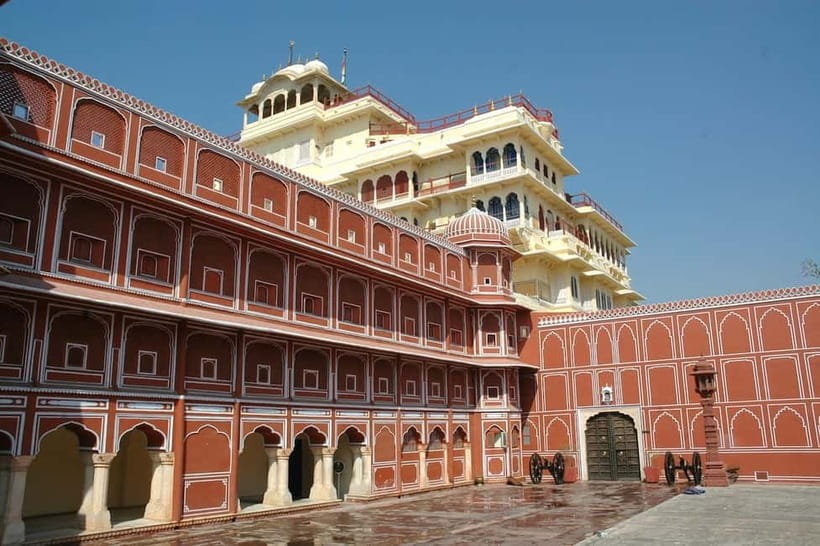
After arms, you shift into the arts and documentation side with the Painting & Photography Gallery, dedicated to paintings, maps, and historic photographs. This is a useful change of pace because it turns the palace from object-focused to documentation-focused.
Maps and old photographs are especially helpful in a place like Jaipur, where the city’s layout and architectural identity matter. You’ll likely come away with better context for what you’ve already seen outside—ways you might not have understood just by walking streets.
If you like museum collections that help you understand place rather than just collect impressions, this gallery will land well.
Rath-Khana: royal transports across three centuries
Finally, the Rath-Khana gives you a different kind of royal storytelling: special display of important royal transports spanning three centuries. Transport objects can sound niche, but in a palace museum they often make sense fast. Royal movement was part of ceremony and public presence. Vehicles and carriers were signals of status, technology, and tradition.
Also note the detail about ceremonies: some objects are still part of annual festivals of the city. That link between past and present is one of the reasons to end your visit here. When a museum item has a living connection, you tend to remember it longer.
If you’re taking photos, this is where a good shot usually feels easy because the displays are designed for viewing. Just be mindful of the palace’s photography rules.
Practical notes: walking, heat, and photo rules
This visit is primarily walking through courtyards and galleries, so comfortable shoes are non-negotiable. During hot weather, carry water. Courtyards can provide shade at times, but the sun can still catch you between stops.
Photography is allowed, but flash photography may be restricted in certain areas. Professional cameras aren’t allowed, so if you’re traveling with a big setup, plan on using your phone or small camera. Pets aren’t allowed either, though assistance dogs are permitted.
A small mindset tip: go slower near the silver urns, in the Diwan-e-Aam hall, and when you reach the Rath-Khana transports. Those are the places where the building wants you to pause and think, not just pass through.
What could go wrong (and how to protect your day)
I’d be honest about risk. One verified booking report claimed the ticket didn’t work at entry and that the palace area was in poor condition with rubbish left behind. That doesn’t mean your day will go sideways—but it does mean you should show up prepared.
Here’s how to protect your time:
- Give yourself buffer time at the ticket counter near Baradari Restaurant.
- Keep a screenshot of your booking and any confirmation details.
- If you hit a problem, calmly ask at the counter and don’t wander off trying to “find another entry point.”
Palaces can be under maintenance, and conditions vary by area and day. The practical goal is simple: arrive early, have backup proof, and expect a bit of unevenness while still enjoying the main sights.
Should you book this official City Palace ticket?
If you want a one-day, do-it-at-your-own-pace City Palace visit that covers the courtyard circuit and key galleries, I think this ticket makes sense. It’s a good fit for first-timers who want major highlights—Pritam Niwas Chowk, Diwan-e-Khas with the Gangajalis, Diwan-e-Aam, Mubarak Mahal textiles, Sileh-Khana arms, plus the Painting & Photography Gallery and Rath-Khana transports.
Book it if:
- You like palace museums with multiple themes (ceremony, governance, crafts, and collections).
- You want official entry tied to the City Palace counter rather than a mystery middle step.
- You’re okay with walking and want a structured route through connected courtyards.
Skip or rethink it if:
- You have very limited mobility and need a highly controlled indoor-only experience.
- You’re relying on the ticket working perfectly at the counter with no backup proof.
Bottom line: for most visitors, the value is in seeing how the palace functions as a whole—courtyards first, then the museum collections that explain why those spaces mattered.
FAQ
How long should I plan for the City Palace Museum ticket?
The activity is valid for 1 day. Plan a full visit window because the experience involves several interconnected courtyards and multiple galleries.
Where do I enter to get the ticket?
You enter the gate to the ticketing counter near Baradari Restaurant.
What major areas will I see inside the palace?
You’ll visit the palace courtyards and galleries, including Pritam Niwas Chowk, Sarvato Bhadra/Diwan-e-Khas (with the Gangajalis silver urns), Sabha Niwas/Diwan-e-Aam, Mubarak Mahal, Sileh-Khana, the Painting & Photography Gallery, and the Rath-Khana. The MSMS II Museum is included and includes four courtyards.
Is photography allowed?
Photography is allowed, but flash photography may be restricted in certain areas. Professional cameras are not allowed.
Are pets allowed?
Pets are not allowed. Assistance dogs are allowed.
Can I bring alcohol or drugs?
Alcohol and drugs are not allowed.
Is the ticket wheelchair accessible?
Yes, the experience is listed as wheelchair accessible.
What’s the cancellation policy and payment options?
You can cancel up to 24 hours in advance for a full refund. You can also reserve now and pay later (reserve without paying today).
Does the ticket cover starting times?
The ticket is valid for 1 day, and starting times depend on availability, so it’s worth checking the time options before you book.