REVIEW · KOCHI
Kochi: Kathakali, Theyyam, and Kalaripayattu Evening Show
Book on GetYourGuide →Operated by Trip Buggy · Bookable on GetYourGuide
Some cultures hit you like a drumbeat. In Kochi, this evening show strings together Kathakali, Kalaripayattu (Kalari), and Theyyam into one powerful sequence. You get explanations in English, a close-up makeup prep, and live music that makes the stories feel immediate.
I especially like how the evening starts with a Kathakali makeup demonstration, so you understand the symbols before the performance goes full force. My second favorite part is the practical round-trip transfers from your hotel in Kochi or Ernakulam, which keeps the night simple after a day of sightseeing. One drawback to plan for: this isn’t wheelchair-friendly, and flash photography is not allowed, so you’ll need to keep your camera ready but your flash off.
In This Review
- Key Highlights You Should Know
- A Single Kochi Evening With Three Different Art Worlds
- Hotel Pickup and Arrival: Why the Transfers Matter
- Kathakali Makeup: The Secret Decoder Ring for the Performance
- The Live Storytelling: When Eyes and Hands Tell the Plot
- Kalaripayattu (Kalari) on Stage: Precision, Speed, and Controlled Power
- Theyyam: Ritual Energy in a Stage-Ready Form
- What You Should Bring (and What to Leave Alone)
- Timing: How Long It Usually Feels and How to Plan Your Night
- Price and Value: Is $11 Actually Good Here?
- Who This Evening Show Fits Best
- If You Want the Best Experience, Do This
- Should You Book This Kochi Kathakali, Theyyam, and Kalari Evening?
- FAQ
- How long is the Kochi cultural evening show?
- Where does pickup happen for this evening show?
- Are transfers included?
- What performances will I see during the evening?
- Is there an English guide?
- Can I take photos?
- What is the makeup demonstration for?
- Is this suitable for wheelchair users?
- What’s included besides the shows?
Key Highlights You Should Know
- Kathakali makeup demo shows the face painting process before the story starts
- Mudras and navarasas help you track emotions and plot without needing to read subtitles
- Kalaripayattu Kalari performance mixes weapon skill, footwork, and acrobatics
- Theyyam ritual dance brings trance-like movement with drums and chanting into a stage setting
- English live guidance helps you follow what you’re seeing, scene by scene
- Photographs allowed, flash banned so you can capture moments without distracting performers
A Single Kochi Evening With Three Different Art Worlds
If you only do one cultural night in Kochi, this is a smart way to cover a lot of Kerala in one sitting. The big idea is contrast. Kathakali is story-telling through highly coded face work and gesture. Kalaripayattu is combat training translated into stage speed and control. Theyyam is ritual performance with a near-religious intensity.
I like that the show doesn’t just throw these at you back-to-back. It guides you through what to look for, including English narration and a pre-show Kathakali makeup explanation. That matters, because these forms are meant to be read. Once you know how to read, the experience sticks.
And yes, it’s also good value. At about $11 per person, you’re paying for three live performances plus hotel transfers and a guide. You’d spend far more than that just on transportation and tickets if you tried to cobble this together yourself.
You can also read our reviews of more evening experiences in Kochi

Hotel Pickup and Arrival: Why the Transfers Matter
This experience is built around an evening pickup and drop-off. You’re collected from your hotel in Kochi or Ernakulam in an air-conditioned vehicle (the exact pickup point depends on what option you select). A driver handles the route, then waits while you enjoy the show, and brings you back afterward.
That sounds basic, but in practice it’s a huge help. Kochi evenings can be busy, and you don’t want to spend your best night negotiating transport or scrambling for the right venue. Here, the show’s start and finish are supported by a vehicle waiting plan.
You’ll likely arrive with enough time to settle in and catch the start of the program. Wear comfortable clothes because you may sit for long stretches and you’ll want to move easily when it’s time to meet performers afterward.
One note from the format: the overall duration is listed as 1 to 7 hours, while the showcase itself is described as around 3 hours. That spread usually comes from pickup timing and how your specific drop-off is scheduled, so don’t plan tight connections right after the show.
Kathakali Makeup: The Secret Decoder Ring for the Performance
The evening begins with Kathakali makeup preparation and demonstration. This is one of the best parts, because it gives context for what you’ll see later in the full performance. You watch performers go through the transformation using natural pigments and detailed facial painting. It’s part artistry, part ritual symbolism—exactly the kind of thing that turns a performance from pretty to meaningful.
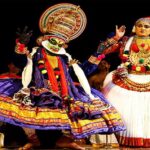
After the makeup demo, you sit for Kathakali itself. Expect the story to unfold under warm lighting that highlights facial expressions and costume details. Live singers and percussion drive the scenes, so you’re not watching a recording. You’re hearing the rhythm that cues the action and emotion.
Kathakali is famous for its expressive system. You’ll notice mudras (hand gestures), exaggerated facial expressions (often explained as navarasas, the emotional states), and stylized movement that communicates more than simple acting. If English guidance is happening during your session, it helps you connect the movement and expressions to the plot from major Indian epics such as the Mahabharata and Ramayana.
If you’ve ever felt lost in dance performances where you don’t know the language, this is the fix. Kathakali is visual grammar. Once you get a few rules, you start reading the story as it happens.
The Live Storytelling: When Eyes and Hands Tell the Plot
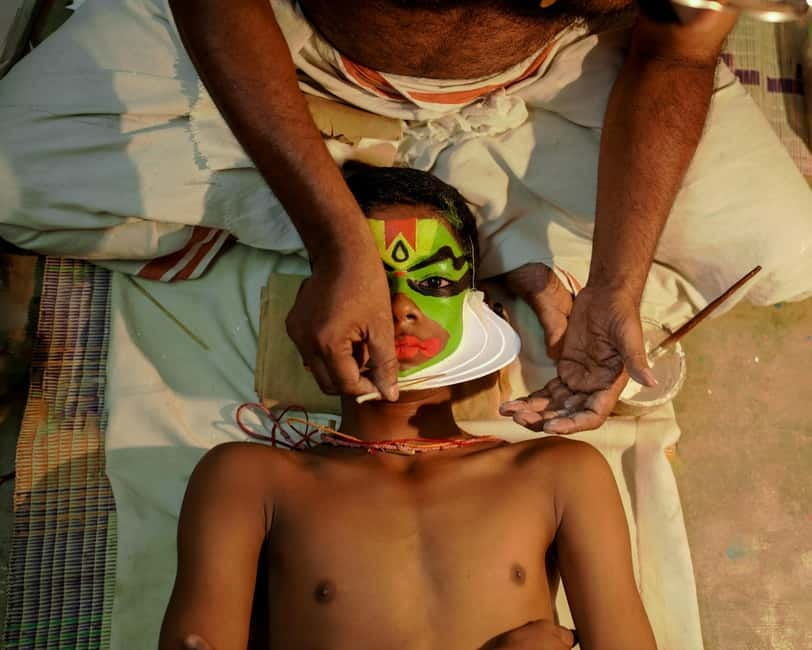
Kathakali performance isn’t just one static spectacle. It’s a sequence of moments, each with its own emotional tone and character intent. The performers use face and hands as punctuation: eyes signal intensity, while gesture tells you what kind of scene you’re in.
In English guidance, you’ll usually get an orientation—what the performers are about to show and why certain expressions matter. That’s key, because Kathakali can look like pure theater until you realize it’s structured storytelling with a specific emotional language.
There’s also a good chance the show will include some interaction or time with performers at the end. Even if that part is brief, it adds something practical: you can ask a question, take a photo, and connect the person you saw during makeup with the character you saw on stage.
Kalaripayattu (Kalari) on Stage: Precision, Speed, and Controlled Power
Next comes Kalaripayattu, often called Kalari, and described as the mother of all martial arts. On a stage, this can be easy to misjudge—people sometimes expect it to look like generic fighting. Here, what matters is the training. You’ll see disciplined movement, weapon mastery, and acrobatic skills that would take years to build.
The Kalari segment is one of the most exciting parts for many viewers because it changes the pace fast. You go from mythic character acting to physical skill demonstrations. The payoff is watching how technique stays controlled even at high speed.
This is also where you’ll understand something important about martial arts: it’s not chaos. It’s form, timing, balance, and repetition. Even when the performance looks dramatic, it reads like training made visible.
Keep in mind that this is still a live event with real performers handling weapons and doing high-energy movements. So don’t bring expectations like it’s a stunt show for laughs. Approach it like a display of expertise.



Theyyam: Ritual Energy in a Stage-Ready Form
Finally, you’ll see Theyyam, a ritualistic dance form. It originates from North Kerala, but in this format it’s presented on stage for cultural appreciation. Expect the feeling of a sacred performance rather than a standard theater dance.
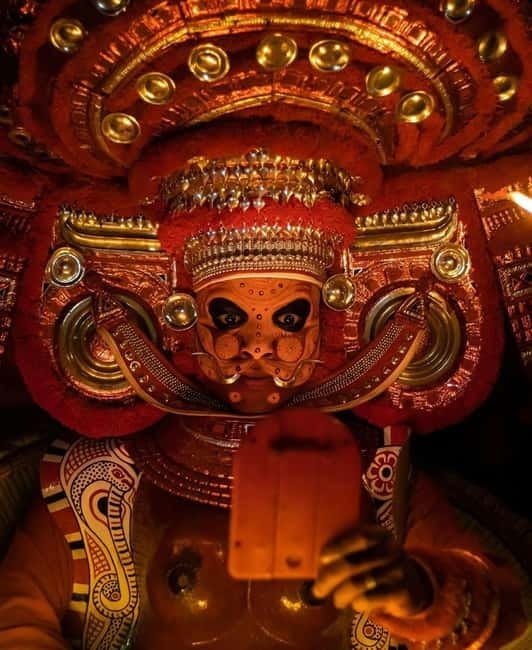
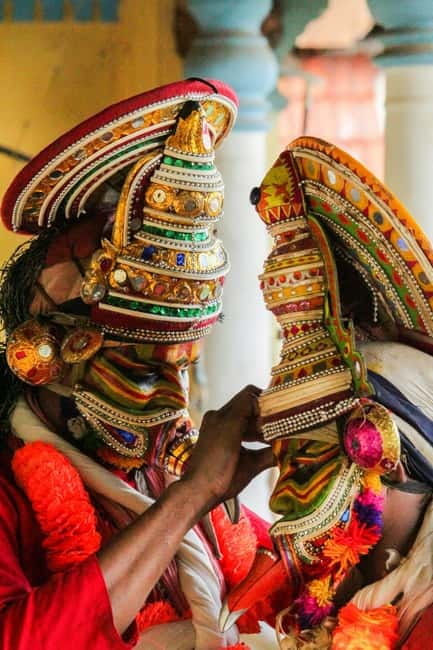
Theyyam is often described as the dance of the gods, and you’ll notice why the moment you see the costumes and makeup. The performer wears elaborate headgear and detailed facial styling meant to represent a deity or divine spirit. The performance includes trance-like movement driven by hypnotic drumbeats and ritual chants.
The expressions can feel intense—almost piercing—because the performer is not just acting a role. They are embodying a spiritual presence for the duration of the piece. If you enjoy spiritual performance or you want something different from the more widely seen classical dance styles, Theyyam is the segment that often makes people pause and pay attention.
What You Should Bring (and What to Leave Alone)
You don’t need much. Just prepare for an evening show where your biggest job is comfort and attention.
Wear comfortable clothes. You’ll sit for a while and you may stand at the end if you choose to interact or take photos.
Photography is allowed, but flash photography is not permitted. That means your phone camera will need good ambient light. If you’re serious about photos, set your camera for low light and keep your flash turned off.
Also, avoid trying to cram the night with heavy plans before pickup. Even if you’re having dinner afterward, give yourself a buffer so you arrive without rushing.
Timing: How Long It Usually Feels and How to Plan Your Night
The show is described as a cultural showcase of around 3 hours, with pickup and drop-off making the total experience time variable. Some sessions are structured so that the Kathakali makeup demo happens in the early part of the evening and the main performances run afterward.
One described schedule pattern put makeup application roughly in the 5–6 pm window, with performances continuing later (often around 6–8 pm). Your exact timing can shift based on the day and how the pickup is arranged, so plan to be free for the whole block rather than just the show time.
If you like to eat before events, eat earlier. If you prefer a late dinner, you can grab it after the drop-off. Either way, don’t schedule a hard reservation immediately at show end—your driver will be waiting, but you’ll still want some cushion.
Price and Value: Is $11 Actually Good Here?
At about $11 per person, this is priced like a budget cultural experience with a lot included. What makes it good value isn’t just the performances—it’s the combination:
- You get three distinct live performances (Kathakali, Kalaripayattu, Theyyam).
- You get English live guidance, which helps you understand what you’re seeing.
- You get round-trip hotel transfers, which can otherwise eat your time and money.
If you priced these separately—transport plus individual tickets plus a guide—the total would likely climb fast. The show’s structure also helps you avoid the common problem in India: you find one performance you want, then scramble to find the rest that evening. This format does the juggling for you.
Who This Evening Show Fits Best
This is a great fit if you want one strong evening that teaches you as it entertains. It works well for:
- First-time visitors to Kochi who want authentic Kerala art forms in a single night
- Anyone who likes performance but also wants help understanding symbols and emotion
- People who enjoy contrast: mythic dance, martial art, then ritual dance
It may be less ideal if you need wheelchair access, because the experience is listed as not suitable for wheelchair users.
If You Want the Best Experience, Do This
Here are a few practical moves that make a noticeable difference:
- Go in curious, not as a judge. These art forms are coded. With guidance, they open fast.
- Keep your camera ready but flash off.
- Listen to the English explanations, even if your schedule says you are tired. They’re what turn spectacle into comprehension.
- If there’s time after the show, use it. The short interaction and photo moments connect the performance to the people behind it.
Should You Book This Kochi Kathakali, Theyyam, and Kalari Evening?
If your goal is to see Kerala’s famous art styles in one night without turning it into a logistics headache, I’d book it. The biggest reason is the combo: Kathakali makeup prep + full performance, Kalari martial art display, and Theyyam ritual dance, all with English guidance and hotel round-trip transfers.
Skip it only if you’re looking for a casual, low-attention show. This one rewards people who watch closely and listen to the explanations.
If you’re in Kochi for a short visit and you want a night that feels both dramatic and grounded in tradition, this is a strong choice.
FAQ
How long is the Kochi cultural evening show?
The experience duration is listed as 1 to 7 hours overall, and the showcase itself is described as about 3 hours.
Where does pickup happen for this evening show?
Pickup depends on the selected option, and it’s available from hotels in Kochi or Ernakulam. The experience also mentions that a driver will be waiting at the end.
Are transfers included?
Yes. Round-trip transfers from your hotel in Kochi or Ernakulam are included, depending on the option you select.
What performances will I see during the evening?
You’ll see Kathakali (including a makeup demonstration and performance), a Kalaripayattu (Kalari) performance, and a Theyyam performance.
Is there an English guide?
Yes. English-language guidance is provided during the experience.
Can I take photos?
Photography is allowed, but flash photography is not permitted.
What is the makeup demonstration for?
It’s a Kathakali makeup prep demonstration so you can see how performers transform into epic characters before the main show.
Is this suitable for wheelchair users?
No. The experience is listed as not suitable for wheelchair users.
What’s included besides the shows?
In addition to the performances, you get the chance to interact with performers and take photographs after the show.